
ACCORD Transformer & Switchgear will provide compact substation systems for upcoming ‘3G Energy Stations’ under the National Highways for Electric Vehicles (NHEV) pilot program, in a move aimed at strengthening power infrastructure for highway-based EV charging.
The development is part of the program’s energy framework, where compact substations will be deployed as central units to manage, stabilize and distribute power across charging stations and associated facilities.
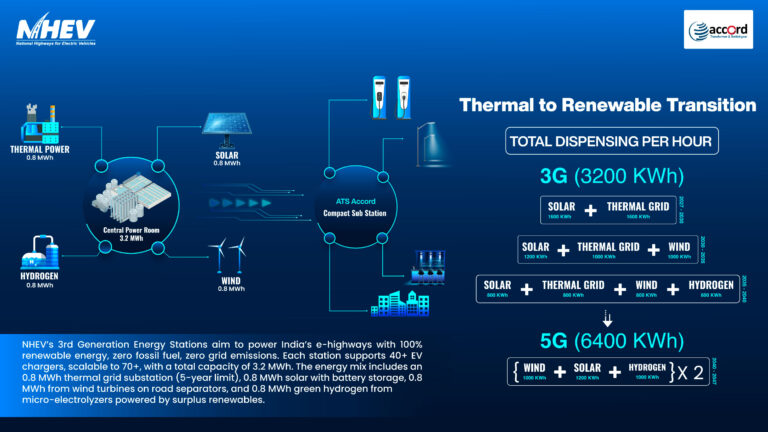
According to details shared by officials, the ‘3G Energy Stations’ are being designed to draw power from multiple sources, including solar, wind, hydrogen and conventional grids. These inputs will be integrated through a central control mechanism before being channeled into compact substations for distribution to EV chargers and auxiliary systems.

The compact substations are expected to support consistent power supply by managing fluctuations in renewable energy generation and handling variations in demand, which are typical in transport corridor-based charging infrastructure. The systems are also being designed to operate across varied climatic conditions to ensure reliability along highways.

Mr. Abhijeet Sinha, National Program Director, National Highways for Electric Vehicles (NHEV), said
“The integration of such systems is critical for scaling public EV charging infrastructure. Ensuring access to stable and distributed power will be key to supporting long-distance electric mobility, particularly for commercial vehicle segments.”

Mr. Pradeep Kumar Verma, Founder & MD, Accord Transformer and Switchgear Limited said:
“Megawatt-scale charging is shaping the future of green mobility, but its true potential depends on uninterrupted, high-quality power. Our Compact Substations act as integrated ‘power hubs’, combining transformers, switchgear, protection, and control systems to deliver reliable, scalable, and efficient energy—enabling NHEV’s 3G Energy Stations to support high-power charging for heavy-duty EVs across diverse terrains.”
The NHEV program has outlined a phased approach to energy sourcing for these stations between 2027 and 2040. Initial phases are expected to rely on a mix of solar and thermal power, followed by the gradual inclusion of wind and hydrogen energy, with a long-term goal of reducing dependence on conventional sources.

Officials indicated that as charging demand increases, infrastructure capacity will also be scaled up to support higher energy requirements, particularly across high-traffic corridors.
The deployment of compact substations is expected to play a role in enabling this transition by supporting efficient power distribution and integration of multiple energy sources within the EV charging network.