

India’s transition to cleaner mobility has made significant strides in passenger vehicles, but the heavy-duty trucking segment has remained a persistent challenge. Long distances, high load requirements, and operational downtime have slowed the adoption of electric trucks—particularly on high-density freight corridors such as the Delhi–Mumbai route.
At the core of this challenge lies a simple issue: charging time. Unlike passenger EVs, heavy-duty trucks cannot afford prolonged halts for charging, especially in a logistics ecosystem where time directly impacts cost. This limitation has historically created a bottleneck, restricting electric trucks from scaling across long-haul routes.
The emergence of battery swapping technology is now reshaping this narrative.
At the Climate Financing VIKSIT BHARAT ‘Ambassador of Change Awards’ MODINOMICS 3.0 2026 edition, Energy in Motion (EIM) and Blue Energy Motors were jointly recognized for addressing this critical gap. Their work marks a shift from theoretical innovation to practical, scalable solutions for India’s e-highways Zero-Emission Trucking (ZET) ecosystem

The breakthrough lies in eliminating idle time. Instead of waiting hours to recharge, electric trucks can now swap depleted batteries with fully charged ones within minutes, ensuring continuity in operations. This model aligns more closely with the operational realities of India’s logistics sector, where efficiency and turnaround time are paramount.
The need for such innovation became evident during earlier trials under the National Highways for Electric Vehicles (NHEV) initiative. In the third tech trial (TTR3), Blue Energy Motors demonstrated early-stage prototypes, alongside alternative fuel solutions such as LNG-powered trucks. While promising, the ecosystem still lacked the infrastructure required for seamless long-haul electric mobility.
That gap began to close with the inauguration of India’s first commercial heavy-duty battery swapping-cum-charging station by Energy in Motion (EIM) at Delhi International Cargo Terminal (DICT) in Sonipat, Haryana. The development signalled a critical infrastructure milestone—moving beyond pilots to real-world deployment.
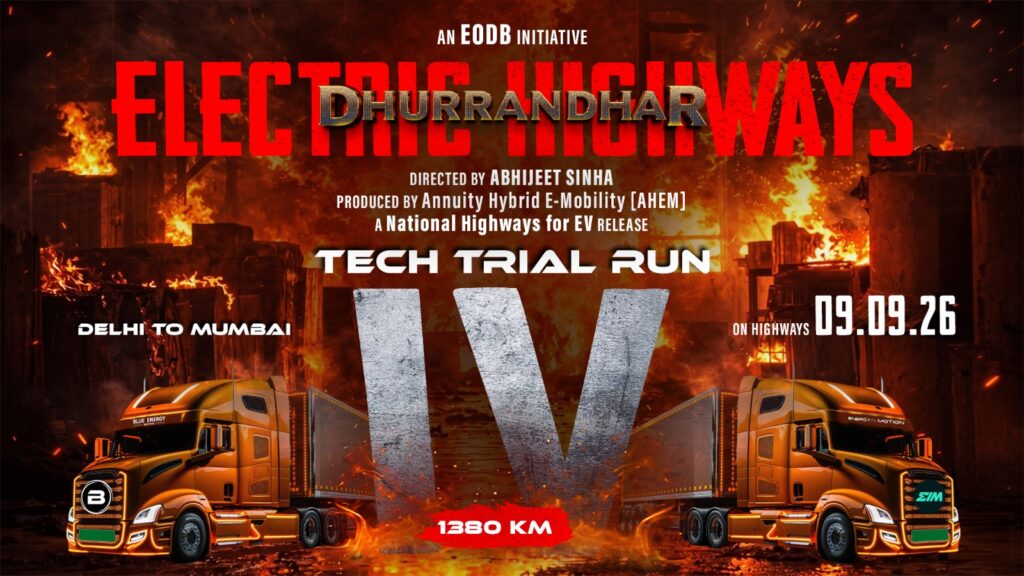
This momentum now sets the stage for the 4th Tech Trial Run (TTR-IV) on the Delhi–Mumbai (1,350 km) corridor, scheduled for September 9, 2026. Now referred to as the “Dhurrandhar of E-Highways,” this trial aims to demonstrate the viability of electric trucks operating continuously across one of India’s busiest freight routes.
In TTR-IV, Energy in Motion and Blue Energy Motors are expected to showcase heavy-duty electric trucks equipped with swappable battery systems, operating within an integrated corridor ecosystem. The focus will not just be on vehicle performance, but on end-to-end logistics efficiency, including turnaround time, energy reliability and infrastructure interoperability. Both the brands have also requested National Highways for EV (NHEV) to extend Ease of Doing Business support for securing larger highway-linked sites along the Delhi–Mumbai corridor to establish battery swapping solutions and dedicated swapping hubs aimed at supporting heavy-duty electric freight mobility at scale.
Supporting this transition is an innovative financing framework developed under the NHEV initiative, in collaboration with the Ease of Doing Business program. By mobilising ₹500 crore through a Viability Gap Funding (VGF) blended finance instrument, the framework reduces investment risk and accelerates infrastructure deployment—an essential factors in scaling Zero-Emission Trucking (ZET).
The broader implications extend beyond technology. Reducing dependence on fossil fuels, lowering logistics costs, and strengthening domestic energy ecosystems are all interconnected outcomes. With India spending significantly on fuel imports annually, such interventions contribute directly to economic efficiency and sustainability goals.
As India advances towards its 2047 vision, the electrification of freight transport will be a defining factor. Battery swapping, once considered an alternative approach, is now emerging as a practical solution to one of the sector’s most complex challenges.
This upcoming TTR-IV trial covering 1,380 km will serve as a critical test — not just of technology, but also of the ability of piloting agencies to provide land on highways, upstream infrastructure, climate financing and time-bound clearances required for accelerated adoption. If successful, following the previous three Tech Trial Runs — Delhi–Agra (225 km) in 2020, Delhi–Jaipur (272 km) in 2022, and Chennai–Trichy (332 km) in 2024 — it could mark the beginning of a new phase where electric trucks are no longer limited by range, but enabled by integrated upstream infrastructure.